The home office has evolved from a temporary workaround into a permanent fixture of modern work. Yet many remote and hybrid professionals still operate with a single laptop screen, unaware of how much that limitation costs them in daily productivity. The constant alt-tabbing, window resizing, and lost context add up — not just in wasted minutes, but in cognitive fatigue and reduced output. This is where portable monitors make a decisive difference. Lightweight, affordable, and easy to set up, they transform a cramped laptop workspace into a full multi-screen environment, unlocking measurable gains in focus, efficiency, and work quality.
The Single-Screen Bottleneck in Home Workspaces
Most home offices start with a laptop on a desk — and that is where the setup often stops. A single 13- or 14-inch screen forces users to layer applications on top of one another. An email client covers a spreadsheet. A video call hides a document. A browser tab buries a design tool. Every time you switch, you lose your place, re-orient yourself, and pay a small cognitive tax.
Researchers have studied this phenomenon extensively. The term “attention residue” describes how part of your mind remains stuck on the previous task when you switch to a new one. Frequent window switching amplifies this effect, making deep work harder to achieve and easier to interrupt. Over a full workday, the cumulative impact is significant — slower task completion, more errors, and greater mental exhaustion. For anyone working from home, where distractions are already abundant, a single screen is an unnecessary handicap.
How Portable Monitors Directly Boost Productivity
A portable monitor addresses this bottleneck by giving you dedicated screen space for each task. The benefits are both immediate and cumulative.
Eliminating context switching
With a second display, you can keep reference material visible on one screen while actively working on the other. A writer can have research notes beside a draft. A coder can display documentation next to an editor. A project manager can keep a timeline open alongside team communications. There is no need to toggle back and forth — everything you need is in your field of view. This reduction in context switching preserves attention and allows for longer, more productive focus sessions.
Enabling true multitasking workflows
Certain workflows are inherently multi-window. Data analysis involves dashboards, spreadsheets, and reporting tools running simultaneously. Financial work requires live market data, modeling software, and communication channels. Customer support agents need ticketing systems, knowledge bases, and chat tools all visible at once. A portable monitor turns a laptop into a workstation capable of handling these parallel tasks without compromise, directly speeding up response times and reducing the chance of missing critical information.
Ergonomic benefits that sustain focus
Productivity is not only about speed — it is also about endurance. Working hunched over a laptop for hours causes neck strain, shoulder tension, and eye fatigue, all of which erode concentration over the course of a day. A portable monitor placed at eye level encourages a healthier posture, reducing physical discomfort and allowing you to work comfortably for longer periods. When your body is not fighting the setup, your mind can stay engaged with the work.
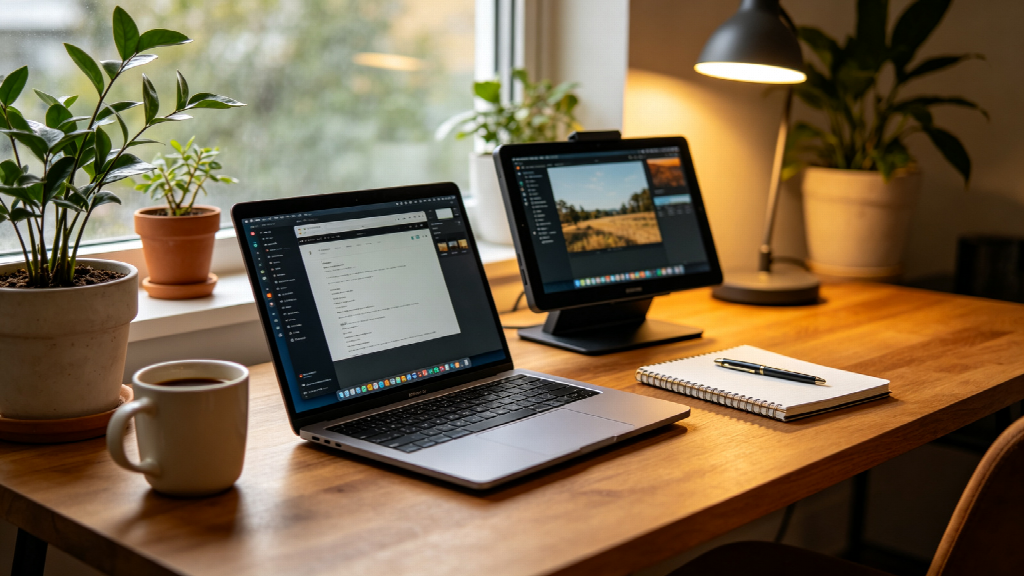
Setting Up a Productive Home Office with Portable Monitors
Creating an effective multi-screen home office does not require a large budget or a dedicated room. A few key elements make the setup work.
First, position the monitors correctly. The primary screen — usually the laptop or the larger display — should be directly in front of you at eye level. The secondary monitor sits to the side, angled slightly inward so you can see it with a gentle head turn rather than a full body rotation. This arrangement minimizes neck movement and keeps both displays within comfortable viewing distance.
Second, use a laptop stand or riser. Raising the laptop to eye level is one of the most impactful ergonomic changes you can make. Pair it with an external keyboard and mouse, and the laptop effectively becomes another monitor in your setup.
Third, manage cables. A single USB-C cable for power and video keeps the desk clean. Use cable clips or a simple cable sleeve to prevent tangles. A tidy workspace reduces visual clutter and supports mental clarity.
Fourth, optimize lighting. Position screens perpendicular to windows to avoid glare, and use a desk lamp for task lighting. Good lighting reduces eye strain and makes long work sessions more comfortable.
Productivity Gains by Role — Who Benefits Most
While almost any knowledge worker benefits from extra screen space, certain roles see particularly dramatic improvements.
Software developers use an extra monitor for documentation, debug consoles, or browser previews while keeping their code editor on the main display. This reduces the friction of testing and iterating, leading to faster development cycles.
Financial analysts and accountants work with complex spreadsheets, live data feeds, and reporting tools. A second display lets them compare datasets side by side and cross-reference figures without constantly switching windows, reducing errors in detailed work.
Writers and content creators benefit from having research, outlines, and style guides visible alongside their draft. This supports more accurate writing and reduces the need to revisit sources repeatedly.
Designers and video editors often require color-accurate displays and ample workspace. A high-quality secondary screen gives them room for toolbars, timelines, and previews without crowding the canvas.
Customer support and sales professionals need to access customer records, knowledge bases, and communication tools simultaneously. A multi-screen setup shortens response times and ensures that important details are never hidden behind another window.
How to Choose the Right Portable Monitor for Your Workspace
Selecting the right monitor depends on your work type, available space, and budget. For general productivity, a 15.6-inch Full HD IPS display is the most popular choice — it offers a good balance of portability, screen real estate, and affordability. For detailed work like design or data analysis, a 17-inch QHD or 4K model provides sharper text and more workspace, though at a higher cost and weight.
Connectivity matters. USB-C with DisplayPort Alt Mode and Power Delivery enables the cleanest single-cable setup. Ensure your laptop’s USB-C port supports video output before purchasing. HDMI is a useful fallback for older devices, but USB-C is the future-proof choice.
For professionals who rely on their display for client presentations or color-sensitive work, a business monitor should offer accurate color reproduction, consistent brightness, and a sturdy build. Features like a protective cover that doubles as a stand, VESA mount compatibility, and blue-light filtering add long-term value.
UPERFECT is a brand worth considering in this category, known for offering a range of portable displays with strong build quality, varied resolutions, and USB-C connectivity that caters to both productivity-focused professionals and creative users. Comparing specifications across brands based on your specific needs will help you find the best match.
Pro Tips for Maximizing Your Multi-Screen Setup
Once you have the hardware, a few software habits amplify the productivity gains. Learn your window management shortcuts. On Windows, Win + arrow keys snap windows to halves or quarters. On macOS, use the green button or third-party tools like Rectangle to arrange windows quickly. Assign specific tasks to specific screens. For example, always keep communications on the secondary display and active work on the primary — this creates a consistent spatial memory that speeds up navigation. Use virtual desktops for project separation, keeping each project’s windows organized across desktops and screens. Take regular breaks — even the best setup cannot replace the productivity benefits of rest. The 20-20-20 rule (every 20 minutes, look at something 20 feet away for 20 seconds) helps prevent eye fatigue during long screen sessions.
Conclusion
Portable monitors are one of the highest-ROI upgrades you can make to a home office. By eliminating the single-screen bottleneck, they reduce context switching, enable true multitasking, and support healthier working posture — all of which translate into measurable productivity gains. Whether you are a developer, analyst, writer, designer, or support professional, adding a portable monitor to your workspace means faster task completion, fewer errors, and less end-of-day fatigue. With USB-C connectivity making setup simpler than ever and a range of affordable, high-quality options on the market, there has never been a better time to expand your screen space and unlock your full productivity potential at home.
That’s where Realwoodworkplans earns its place as your go-to advisory. The site is built around woodworking plans, DIY guidance, project calculators and process explanations that help you move from “I have an idea” to “I know what I’m cutting.”

